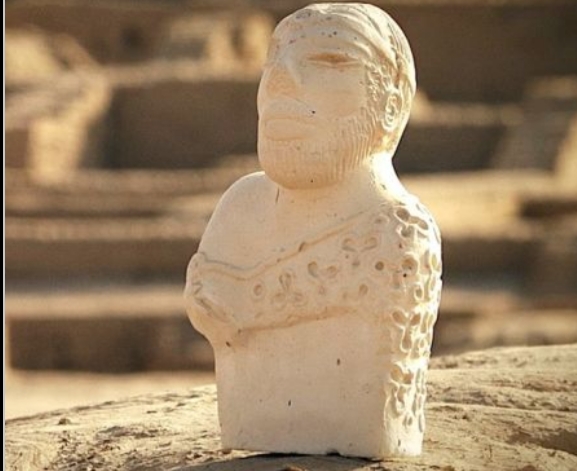
.. When I was in this ancient city of the world, I checked its environment and the light breeze reduced the intensity of the heat. Walkways and wells were built through millions of red bricks, which seemed to connect the web of different neighborhoods. An ancient round Buddhist dome stood in a state of decay, beneath which lay a wide staircase. A swimming pool is built. There were only a few people here. I was in the ruins of the city of Larkana, an hour’s drive from the main city.were, the name of this ancient city was Moin which was Daru. Today only ruins remain of the city, 4,500 years ago it was not only one of the oldest cities in the world but a thriving region with the most modern infrastructure for its time. meaning ‘mound of men’ in the Sindhi language, was once the largest city of the flourishing Indus Valley Civilization (also known as the Harappan Civilization) which spread from northeastern Afghanistan to northwestern Afghanistan during the Bronze Age. Saw its rise to India. Thought Moen Jo Daro is said to have been inhabited by at least 40,000 people, a city that flourished from 2500 BC to 1700 BC. Irshad Ali Solangi is a local guide who is the third generation of his family working in Moenjo Daro. Solangi explained that ‘it was an urban center with social, cultural, economic and religious links with Mesopotamia and Egypt.’But compared to the cities of ancient Egypt and Mesopotamia, which developed at the same time, Very few people outside Pakistan have heard the name of Moin Jo Daro. This 1700BC, and to this day no one is quite sure why the inhabitants of the city migrated or where they went. are covered Archaeologists first visited the area in 1911 after hearing reports of brickwork . However, the Archaeological Survey of India (ASI) initially rejected the idea that the bricks recovered from the site could be of ancient date and consequently added the site.It remained unsafe for years. Its importance was not realized until RD Banerjee, an ASI officer, was posted here in 1922. He believed he saw a buried dome at the site, a mound-like structure where Buddhists usually sat for meditation. His opinion led to excavations in the area, and in 1980 it was declared a UNESCO World Heritage Site. Moen Jo Daro has been included in the list of World Heritage Sites. The remains of this ancient city, especially by the British archaeologist Mah Sir John Marshall Discovered, they give an idea of the quality of its urban life, unprecedented in history. UNESCO has hailed Moen-jo Daro as the ‘best-preserved’ ruin in the Indus Valley. A striking feature was the sanitation system, which was far more advanced than its contemporaries, while drainage and private latrines were seen in Egypt and Mesopotamia, but they were only a luxury for the wealthy. Moin Jo Daru had hidden latrines and covered drains and drains built in places. Since the excavation.ShruA.D more than 700 wells have been excavated, in addition to a system of private baths, including a huge ‘Great Bath’ measuring 12 meters by 7 meters for communal use. Surprisingly, many private residences have latrines. found and the waste was secretly disposed of through a sophisticated sewage system. This is the complex and sophisticated system of a city we would like to live in today. Eight Professor Uzma Z Rizvi said that this is a complex cityModernism is the system we would like to live in today. Uzma Z. Rizvi wrote a paper on this ancient city in 2011 titled ‘Moin Jo Daro, The Body, and the Domestication of Waste’. Moin Jo Daro The inhabitants also understood their environment. Since the city was located just west of the Indus River, they built impressive flood defenses and drainage systems to protect themselves from the annual floods. Moreover, Moen was a key hub for maritime trade links between Central Asia and the Middle East It extended to the Middle Ages. Over the centuries, they produced intricately carved pieces of pottery, jewelry, sculptures, and other objects that have been discovered everywhere from Mesopotamia to present-day Oman. The inhabitants of Moen Jo Daro produced very high quality carved pottery. Today, the ruins of this ancient city have been transformed into a local park with picnic tables and shade trees and lush gardens. However, tourists from other parts of Pakistan rarely visit this remote location and the number of foreign tourists Very rare..I wandered through the ancient intricate streets of this city and saw many wells, high walls that provided much needed shade, and covered drains for drainage that surprised me. Everything was built thousands of years ago. The Moen Joe’s mastery of the art of sanitation and waste water disposal were not the only high qualities that distinguished the inhabitants from other early civilizations. Despite the lack of machines, archaeologists have found standard building materials The use of is especially appreciated. All bricks have a ratio of 4:2:1, although they are not of the same shape. It is important to know that all these bricks are following a similar design sensibility. There is a sense of how they want their city to look. If you make everything proportional, even the spaces you walk through, naturally follow a certain design that also shows a sense of proportion.’ I was dried and burned in a kiln, thousands of years later Despite this, they remain strong. And while grandiose architecture such as havelis, synagogues, and other social status-determining buildings and other indicia do not appear in Moen Jo Daro designs, Uzma Rizvi explains their absence as meaning that Not that monumental architecture did not exist. He said that “the memorable thing of this city is the basic structure of this city.” The two and a half meter deep communal bath is a structural structure that makes this city prominent.As I headed towards the upper part of the city, I found myself in the lower part of the city, which covers more than 300 hectares of Moin Jo Daro and would once have been home to the city’s most affluent neighborhoods. The real secret of the city’s success was its high-quality organization. Dozens of narrow streets intersect at 90-degree angles in a grid of planned streets. The use of thresholds in the doorways of local homes, including bathrooms, is not unlike what you would find in any house or building today.If you look, you know someone has thought about what it means to be inside and outside.’Moin Jo is a small building in the grassy area of Daru which houses a museum, after visiting it you will be able to see it. There is more awareness about the ruined city. Hundreds of decorative seals, often depicting a single animal, as well as sculptures, jewelry, tools, toys, and fragments of pottery have been carefully excavated from the site. Arranged on rows of glass shelves, Antiquities were well preserved. Navadra among them were two statues: one of a young woman wearing jewels and the other of a well-dressed man who appeared to be of high status. Rizvi explained that it would be a big man from the elite class, we don’t know if he was a priest or a king. When it comes to body grooming and body care, attention to detail is what drives us. It gives us an awareness of how (residents) were treating themselves, their bodies. He clearly had an understanding of mathematics. Clearly, there was an understanding of geometry clear. As such, there was an understanding of fashion. 700 wells have been discovered since the excavation of Moen Jo Daro However, such a great detail that can tell a lot about the lives and times of the twenty-two people of this ancient city is still a mystery. While ancient texts often reveal the secrets of civilizations, this was not the case with the Moenjo Daru, whose inhabitants used a script known as the Indus Valley style of writing. “It was a pictorial language with more than 400,” said my guide Solangi There were letters. No one has been able to read it yet. What happened to Moen Jo Daru is another mystery that has yet to be solved. Overall, researchers are not sure why the city was destroyed or abandoned around 1700 BC, although a large But it is believed that climatic factors may have played a role in its destruction. Nevertheless, Rizvi explained that the disappearance of Moin Jo Daro was not a sudden event. “The city itself was not suddenly emptied,” he said. Around 1900 BC You notice that a change takes place, the traces of the people living in the city begin to diminish materially. Not that all are gone, but there are certain neighborhoods that you start with. In the later periods the population is not the same as in the earlier periods. You see the pace of people leaving the city is slow. After thousands of years now, after the devastating super flood in Pakistan in August 2022, the city is once again under threat. Dr. Asma Ibrahim, archaeologist and museologist who traveled across the country, who are engaged in conservation work, confirmed that the damage to the Moen Jo Daro site was less inundated than archaeologists had originally feared. Many of the houses were two-storied, built on thick, strong walls. Their roofs were high to keep the houses ventilated and cool. When asked how Moin Jo Daro could be preserved in the future, Ibrahim recommended the use of channels to drain excess water away from the site. but also emphasized the need for a ‘long-term strategy ‘A long-term plan for the area will not only benefit archeology but also many local people like Solangi who live in the vicinity. The round Buddhist dome is clearly visible from Solangi’s house in Dand village. He emphasized that ‘for me, Moin Jo Daro is a treasure of ancient civilization. We must protect it for future generations. As we walked along the brick paths, I agreed with Solangi. I thought of the orderly streets and the below-ground brick cisterns called the ‘Great Baths’.It has also been carefully reviewed. A widespread sanitation system far superior to some of the basic infrastructure seen in Pakistan today. As Solangi famously put it ‘taxes collected from the people were spent on public welfare. ‘ And their investment paid off, at least for a while. Moenjo Daro was thriving and the inhabitants were able to enjoy a standard of living far beyond the standards of their time. A rotten one on the way back to Larkana a few hours later Sitting in the auto-rickshaw, I could not help but thank him. Buried in sand and mud for thousands of years, Moin is seemingly buried forever in the plains of the Indus. One of the most modern cities can be seen once again. And more often than not you’ll find clean, rutted roads.
Ziadnasir
Beauty, Brazile, British, China, Cricket, Crises, daffodils, Education, Election, England, environment, europe, Facebook, FIFA, Flowers, Food, FootBall, Gold, Goregia, Homosexuality, Homosexuality Impowerment, Human Rights, Impowerment, Iran, Japan, Korea, Love, Mary Elizabeth Politics, Mary Elizabeth Social-Evils Politics, Nature, OIL, Pakistan, Parliament, Pentagne, Politics, Putin, Qatar, Queen, Russia, Terrorism, trees, Trump, UK, ukraine, UN, USA, WAR, Women, Women Impowerment, WorldCup, Yolkshire, Youth, Youtube
 The World Stories
Leave a comment