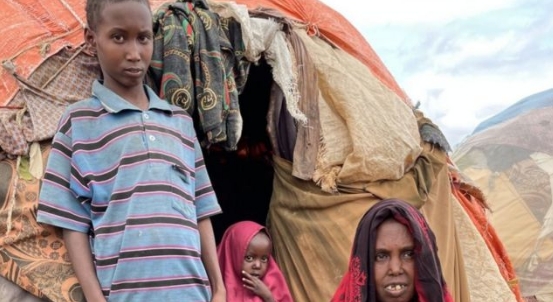
I may never be able to feel the intensity of pain and sorrow, nor can I judge the feelings of parents because I have not yet become a father. If you are a mother or father, you should feel this pain when You lose yourself just because you cannot feed them two meals a day. How painful that one morsel costs a life. One such child, eleven-year-old Dahar, had tears streaming down his cheeks. ‘I just want to live in these conditions,’ he said in a low voice. On the outskirts of Baidua city Sitting on the mud outside a makeshift tent in Qaim Khem Basti, Dahir was told to shut up by his frail mother, Fatima Umar. She said, ‘Your tears will not bring your brother back, everything will be fine.’ Fatima’s other son, ten-year-old Salat, died of starvation two weeks ago. He was killed shortly after walking three days from his village to Bedua’s encampment. His body was buried in rocky ground a few meters from his new home. However, his grave is already covered with Rubbish It’s hard to see because the new arrivals have camped around her. Fatimah said, looking at her nine-month-old daughter cradling her and six-year-old daughter Maryam who was coughing with a cough. I can’t grieve for my son, I don’t have time for that, I have to find work and food to keep other children alive.’ The camp is on the other side of a dirt road that leads southeast to Mogadishu, Somalia’s coastal capital. The homeless people there gave Metheny told more harrowing stories of long journeys in search of food in this famine-stricken country. ‘I didn’t have the strength to bury my daughter’ A new survey has revealed that nearly two-thirds of young children and pregnant women in the camps are severely malnourished, and that, in addition to rising death rates, could signal an already imminent famine. It should have been declared. Fatima said that ‘I saw my daughter (three-year-old Farhr) dying in front of me and I could not do anything.’ He has his He had walked with the children from his village for about 15 days to reach this tent. He continued saying, ‘I carried him in my lap for ten days, we had to leave him on the side of the road. , we didn’t have the power to bury it, I could hear the rattles coming up close. Fifty-year-old Habiba Muhammad twists a rope in her hand and says, ‘I didn’t bring anything with me on the trip, there was nothing left at home, the livestock had also died, the fields were dry.’ She knows that she will never return to her village Will not go back. Rapidly changing conditions due to climate change and successive droughts have now threatened the centuries-old way of life in Horn of Africa. And Jhuda was busy setting up her tent with plastic sheets and pieces of cardboard, hoping to finish it before the night got colder. After this work was over, she went there in search of food and any medical assistance for her five children the ward of the city’s main hospital, Dr. Abdullah Yusuf sometimes moves from one bed to another to examine his small and very weak and miserable patients. Most of his patients are between the ages of two months and three years. All are severely malnourished, some have pneumonia and many are suffering from an epidemic of measles. Few of these newborns are able to cry. Some have badly damaged skin. and has burst after inflammation due to extreme hunger and famine. Dr. Abdullah’s own’Many of them die before reaching the hospital,’ said team members as they watched the two-year-old boy search for a vein in his frail body to administer a drip. Although Somali officials and international organizations have been sounding the alarm of famine in the southwestern region for months, Dr. Abdullah said his hospital is already short of basic items, including nutritional supplements for children. Expressing concern, he said, ‘Sometimes we run out of medicine, it’s really a Shame It happens because people are dying and we can’t help them. Our local government is not dealing with it properly. It has not planned to take care of the drought or the displaced people who come here as a result.’ A local government minister admitted that there had been shortcomings. “We need to be more proactive and in the right direction, and be more efficient,” Nasir Arush, the minister of human affairs for the southwestern state, said on a brief visit to the camps on the outskirts of Baidoa. But he insisted.”More international support is key to this work,” he said. “If we don’t get the aid we need, thousands of people will die.” What we are doing today, we needed to do three months ago. In fact, we are behind and if nothing is done soon, I think there will be a humanitarian tragedy in this region.’ The process of officially declaring a region as drought-prone is complex, relying on detailed data and sometimes not being declared for political reasons.would go Kate Foster, Britain’s ambassador to Mogadishu, described it as ‘essentially a technical process’. He pointed out that during the 2011 drought, ‘half of the 260,000 deaths occurred before famine was declared.’ The presidential envoy, who is leading Somalia’s international efforts to secure more aid, specifically thanked the US government for the recent aid, saying it ‘gave us hope.’ But Abdurrahman Abdeshkoor warned that without more help, a local crisis in one part of SomaliaCan quickly get out of control. “We were sounding the alarm… but the response of the international community was not appropriate,” he said, speaking by phone from Toronto, Canada, while traveling. ‘Famine was prophesied. It happens (already) in some places, in some places in Somalia. Women are leaving and men are staying behind Although estimates vary, the Bedouin population has nearly quadrupled in the past few months to around 800,000 people. And anyone watching immediatelyYou will learn a surprising fact that almost all newcomers are women. Somalia is at war. Since the fall of the central government three decades ago, the conflict has persisted in various forms, affecting almost every part of the country, with armed groups separating men from their families to fight. Like many people who arrived in Bedua, Hadijah , Abubakar arrived here recently after fleeing an area controlled by Somalia’s militant Islamist group al-Shabaab. of Bedua Sitting with her sick child in the hospital, she said, ‘I am still getting calls from my family. There is a fight between the government and al-Shabaab. My relatives have run away and hidden in the forest.’ Other women told of husbands and young sons not being allowed to leave militant-controlled areas and years of extortion. Baidua itself is not Al-Shabaab-held territory, but it is also not a safe haven for refugees. International aid organizations, and foreign Journalists Movement here requires heavy security, and any travel outside the city limits is considered extremely dangerous. “We are seeing populations that are under siege,” said Charles Nzuki, head of the United Nations agency UNICEF in central and southern Somalia. Sometimes it feels quite hopeless.’ According to some estimates, more than half of the population affected by the current drought lives in areas controlled by al-Shabaab. of the US Government to prevent the financial gain of designated terrorist groups Reaching out to many disadvantaged populations is complicated by strict laws. But international organizations, and Somali officials, are working with smaller local partners to increase access to these populations and are now planning to send aircraft to some disputed areas. One aid worker, speaking off the record, acknowledged that it was almost impossible to guarantee that no food or funds were reaching al-Shabaab. He said that we should not be so innocent (Al-Shabaab).It charges tax on goods and even cash donations.’ Over the years, the militant group has built a reputation not only for violence and intimidation, but also for dispensing swift justice in a country where government corruption is rampant. In at least four villages near Baidwa, al-Shabaab operates a network of Sharia courts that are used by city residents and reportedly people from Mogadishu and beyond to resolve business and land disputes. Local populations against al-Shabaab in the northeast of the Country And tribal militia rebellions have been witnessed. Who now have the support of the central government. That resistance has driven al-Shabaab out of dozens of towns and villages in recent weeks The military gains have sparked optimism in the region, but it is unclear whether this will help in the fight against famine, or just distract the Somali government. Beneficial or not, I think it will make more people homeless. Or the government should liberate more areas and maybe more Awa Help can reach. So we are looking at it from every angle. In Bedua itself, the city’s narrow streets bear the brunt of decades of conflict and mismanagement. The price of staples like rice in the city has doubled in the past month. Many residents blame the drought, but others cite other reasons. “Flour, sugar, oil, they all have increased almost at the same rate,” said Shukri Mualim, 38, as he walked past his dry well and dry land for vegetables. Sometimes we eat Have to leave. I heard about the war between Russia and Ukraine. That, people say, is the root cause of these problems.’While the immediate focus is on the fight to prevent a famine spreading across the region, Somalia’s new government is also trying to find answers to more questions about the future. “Responding to famine, fighting al-Shabaab, and campaigning for access to finance for (international) climate justice is a challenging task,” says Abdel Rahman Abdeshkoor. ‘We have a young population, They are largely expatriate and have great talent. It gives us hope. But it is challenging, but we have no alternative.
Ziadnasir


 The World Stories
Leave a comment